
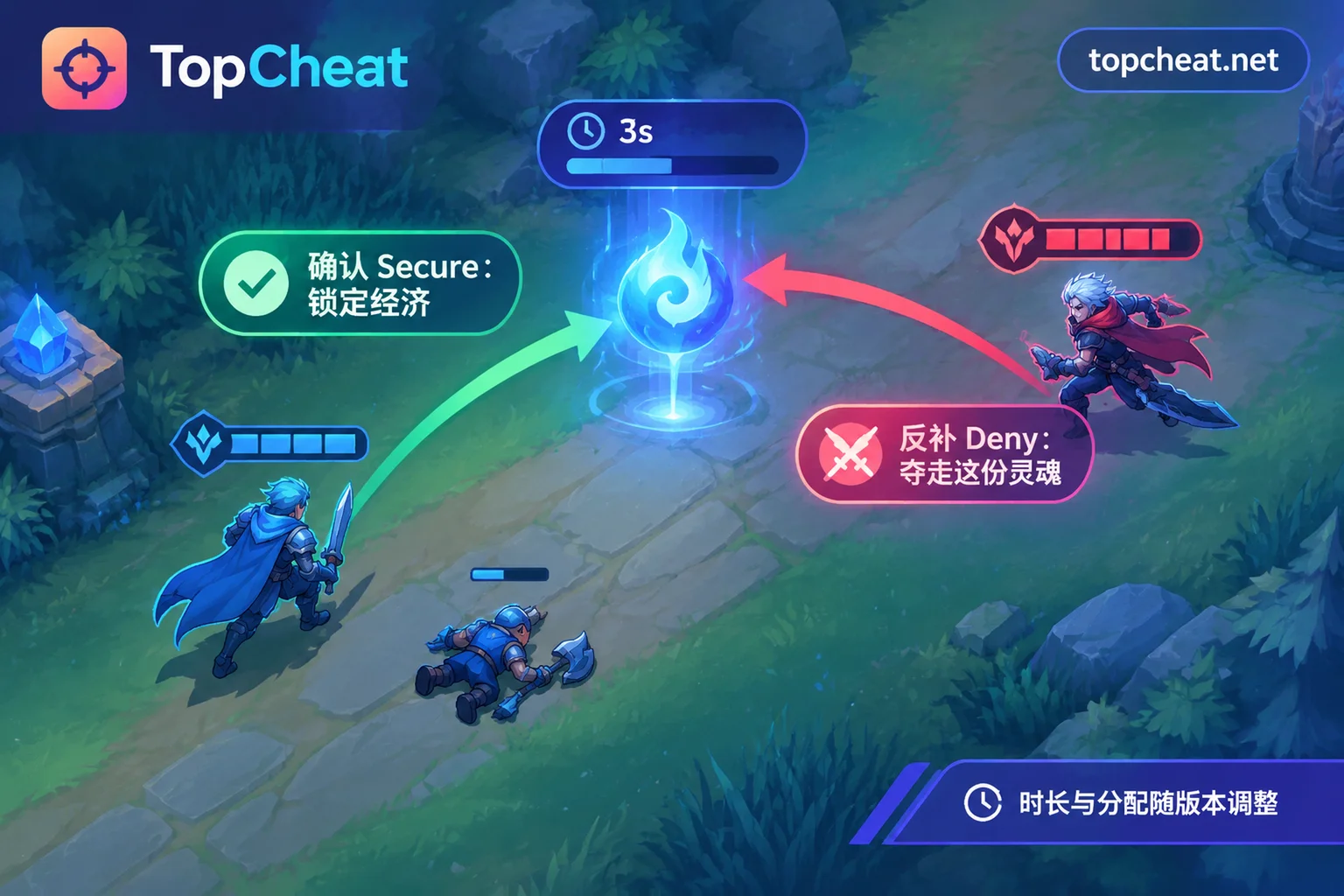
In Deadlock, last-hitting is about the Soul Orbs that rise after a creep dies. The "last-hit and deny assist" listed on the TopCheat Deadlock product page automatically or semi-automatically locks onto Soul Orbs within the判定 range and fires: shooting your own orb is a Secure, locking in that economy; shooting the enemy's orb is a Deny, preventing the opponent from getting that income.
This module saves the reaction time of watching the orb, moving the crosshair, and firing. The game's economy rules do not change. Whether you can secure a particular orb still depends on how fast your hero's bullets travel, how far you are from the orb, your network latency, and the判定 rules of the current Playtest build.
First, Understand What You Are Fighting Over During Laning
Deadlock's laning economy mainly revolves around Soul Orb resolution:
- After a creep dies, a Soul Orb rises. The killer can shoot it to Secure, locking that soul to themselves.
- The enemy can shoot it first while it floats. If they do, it is a Deny, taking that soul and denying the killer that income.
- The float has a time limit. Sources mention that if no one destroys it within about 3 seconds, the orb automatically goes to the killer's side. In actual laning, both sides often fire the moment their bullets can reach it, rarely waiting for the timer to end.
- Not every bit of economy must be contested. Creep economy has been adjusted many times across versions; some is granted directly on landing or becomes a ground orb. The floating Soul Orbs are the main object both sides fight over.
A single orb's difference is small, but missed orbs and denied orbs accumulate during laning and translate into item and level disadvantages. The last-hit and deny assist is meant to address this continuous loss.
What the Last-Hit and Deny Assist Covers
From the creep falling to the Soul Orb being destroyed, there are four steps: noticing the orb rise, determining which side it belongs to, moving the crosshair onto the orb, and firing to destroy it. The product page describes this module as locking onto friendly or enemy Soul Orbs within the判定 range and destroying them, covering the most reaction-intensive parts of the latter three steps.
The exact trigger method for automatic and semi-automatic modes, and whether the range is adjustable, is subject to the current product page description. The official site has not published response thresholds or smoothing parameters for different heroes, so this article does not speculate.
The same product page also lists three other modules with different roles:
- Projectile prediction aimbot: targets moving heroes and calculates lead. The last-hit and deny module targets Soul Orbs; the two handle separate tasks. To understand how "prediction" works in other games, see What Is Marvel Rivals Aim Assist Projectile Prediction.
- Hero ESP: shows enemy hero positions. When contesting orbs you often need to step forward; you can first check whether anyone nearby is ready to catch you, then decide whether to go for that orb.
- Jungle timer: manages economy outside the lane, used to schedule jungle camps after clearing a wave.
What Determines Whether It Secures or Not
1. Bullet travel time. Deadlock bullets are not hitscan; projectile speeds vary noticeably between heroes. At longer distances, the opponent may hit before you. The assist can move the firing timing as early as possible, but it cannot change the bullet's own speed.
2. Simultaneous shots. When both sides fire almost simultaneously, the server determines who hit first. Community discussion mentions that the game has added latency compensation and simultaneous-fire判定 handling to reduce the disadvantage for high-ping players. Such details change with versions and cannot be treated as fixed rules. With high network latency, your orb-securing success rate will still be affected.
3. Distance and positioning. If the orb is outside the判定 range or blocked by terrain, the module cannot act. Close-range pressure can make opponents afraid to contest; that advantage comes from positioning and applies whether or not you use the assist.
4. Playtest updates. Deadlock is still in Valve's Playtest phase and updates frequently. Soul distribution, projectile collision, and server-side anti-cheat判定 are constantly iterated. Settings that worked in the previous version may not work the same after a major update, and the official site does not promise universal compatibility across all versions.
Check These on the Product Page Before Ordering
- Current status: First confirm on the TopCheat Deadlock assist product page whether it is online, in testing, or under maintenance. When the game has just updated, rely on the latest status shown on the page. For differences between games that are on sale versus in testing, see Which Games Does TopCheat Support.
- Module scope: Whether the last-hit and deny assist, hero ESP, projectile prediction aimbot, and jungle timer are all included in the version you intend to buy.
- Plans and binding: The official site offers daily, weekly, and monthly cards per game. Prices, card key scope, device binding, and unbinding conditions are subject to the Deadlock page; do not apply descriptions from other games. Since there are many major updates during the Playtest, you can first use a short-term card to confirm compatibility with the current version before considering a long-term card.
- Account risk: Using third-party assists violates the game's user agreement, and accounts may be penalized. Server-side判定 is also adjusted with versions, so no version can be called absolutely safe.
In summary: the last-hit and deny assist in Deadlock improves reaction speed and consistency in securing Soul Orbs during laning. Its effectiveness ceiling is limited by projectile speed, latency, and version rules. Before buying, checking the product page's current status and plan conditions is more useful than just looking at the feature list to decide whether this module is worthwhile for you.



Comments(0)